


Pilot Schedulers Compare PBS Notes
Scheduling Workshop: Preferential Bidding Systems
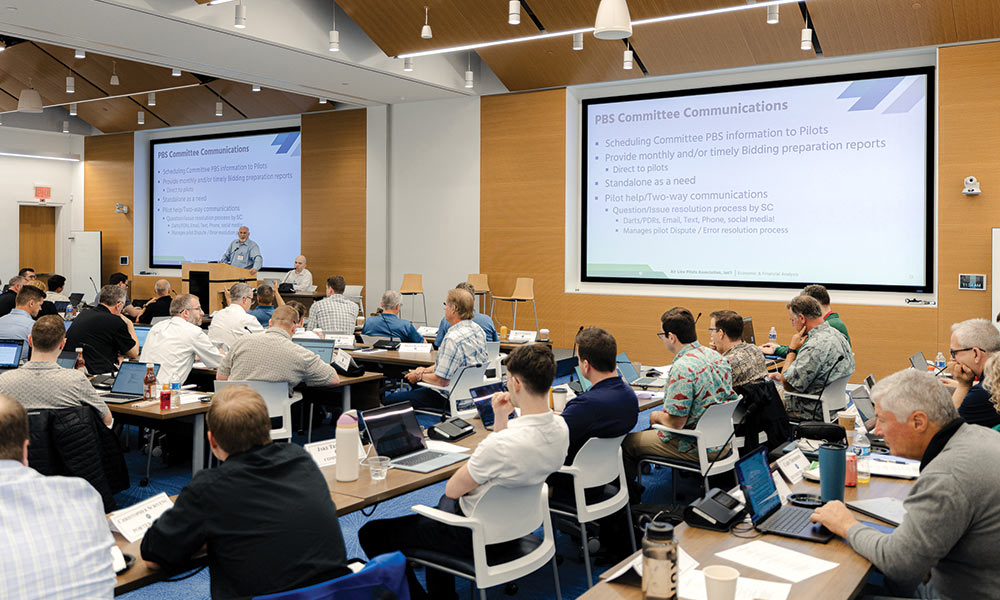
Sixty-four Scheduling Committee pilot volunteers from 21 ALPA pilot groups gathered at the Association’s McLean, Virginia, headquarters on May 12–13 to take part in the union’s Preferential Bidding System (PBS) Scheduling Workshop. The majority of ALPA pilot groups use PBS software to build their monthly flight schedules.
PBS empowers pilots to construct regular and reserve lines of flying by choosing criteria from a host of options, including preferred days off, commutable starting times, and desired or undesired pairings (or rotations). Choices are awarded based on seniority, contract terms, company policies, and other critical factors. As progressive as this approach is, PBS software can be complicated and confusing, with varying algorithms and terminologies depending upon the vendor.
Sharing Experiences on Structure, Responsibilities, and Technology
Jeff Nooger, a senior scheduling and work rule analyst, assisted by Adam Brendle, a scheduling and work rule analyst—both former airline pilots now working in ALPA’s Economic & Financial Analysis (E&FA) Department—moderated the two-day event. Topics covered during the workshop included Scheduling Committee structure, responsibilities, and PBS technology. Much of the agenda was open-ended, with the moderators initiating a series of organic conversations, encouraging meeting attendees to share their experiences and highlight “what works and what doesn’t.”
Participants also discussed issues such as the challenges in interpreting certain interfaces, the level of vendor support available, and making strategically layered preferences work within a given system. It’s important for pilots to know when their bid choices are impractical as well as when one expressed preference conflicts with another.
In addition, several pilots provided demonstrations of the vendors and versions of the PBS systems they use. F/O Paul Campos (Delta) commented on his pilot group’s Scheduling Reference Handbook and the learning management systems being developed by the union’s Communications Department to educate pilots about NavBlue, the most commonly used PBS vendor among ALPA members. Four training segments have been produced so far, and this guidance is available to all Association pilots through ALPA Academy.
“Bidding requires a foundational knowledge,” said Campos, stressing the value and importance of sharing these kinds of training tools among the union’s pilot groups.
Capt. Travis Bealmear (United), PBS expert, highlighted enhancements to United’s latest Jeppesen PBS platform interface, designed by United pilots and United Airline’s Digital Technologies based on pilot feedback and modernization goals. He noted that new features include guided steps; criteria definitions; self-help guides; integrated learning videos; autobid, an automated bidding tool; real-time bid feedback tied to seniority; and automated notifications for bid openings and closing, unsubmitted bids alerts, and published awards—helping pilots to bid more efficiently and reduce common errors.
Capt. Doug Marchese (JetBlue), ALPA’s Flight Time/Duty Time Committee chair, discussed PBS and its potential influence on pilot fatigue. Pilot schedules can quickly become unmanageable when they include awarded preferences that conflict. Marchese pointed out that because PBS doesn’t always consider pilot workload, airlines sometime apply biomathematical models and fatigue awareness tools. However, additional mitigation considerations are needed.
Breakouts Highlight PBS Vendors and More
On the second day of the workshop, attendees participated in one of three vendor breakout sessions. Among them, Capts. Ben Brooks (Alaska) and John Shea (JetBlue) highlighted the features of the NavBlue applications their pilot groups use. They noted that NavBlue has recently provided better testing, has issued additional maintenance releases, and is dedicating more resources to real-time support. The pilots also observed that, as of April 1, Airbus began integrating NavBlue (flight operations) and Skywise (digital solutions) into a single, wholly owned subsidiary called Skywise.
Other breakout sessions featured a review of IBS (AD OPT), a PBS vendor that Air Canada, Endeavor Air, FedEx Express, PSA, WestJet, and WestJet Encore pilots use. The third group reviewed the Jeppesen system used by United pilots.
The monthly work schedule is a crucial component of pilot quality of life. Therefore, it’s important for all ALPA members to understand and take full advantage of their airline’s schedule bidding systems. With a proper grasp of how to navigate PBS platforms, pilots can optimize their choices and even secure preferences normally considered beyond their seniority reach.
Next Scheduling Workshops
E&FA is planning to present two additional PBS conferences later this year: the Pairings/Rotations Construction Scheduling Workshop on July 28–29 and the Day of Operations/Crew Desk Scheduling Workshop on September 30–October 1.

Featured Articles


